California Relief & Court Supervision
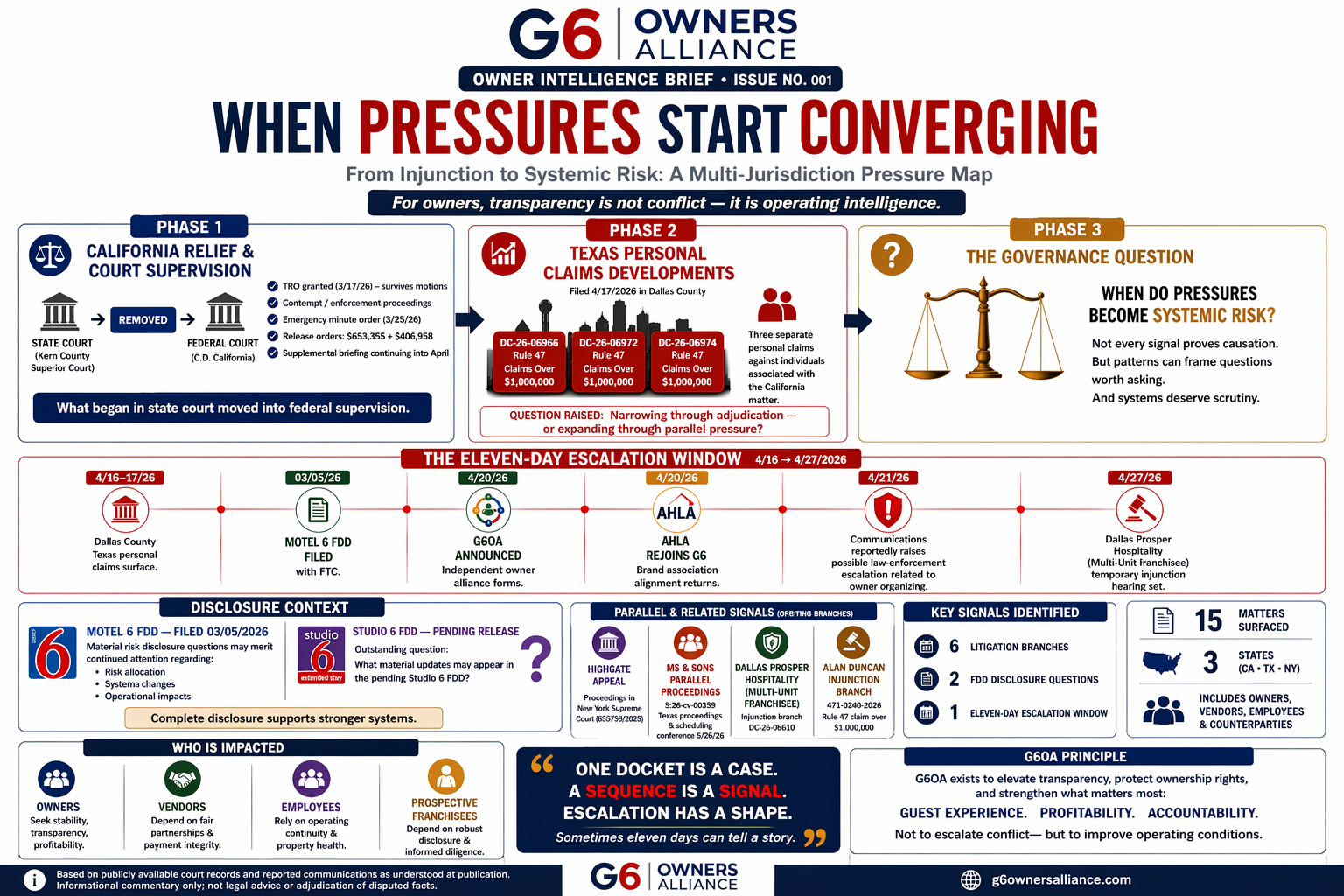
What began as state-court activity in Kern County, California, moved into federal supervision in the Central District of California. Public records reflect a temporary restraining order granted on March 17, 2026 that survived motion practice; subsequent contempt and enforcement proceedings; an emergency minute order on March 25, 2026; release orders totaling $653,355 and $406,958; and supplemental briefing continuing into April.
The factual significance is structural rather than conclusory. The matter did not end in state court — it migrated to federal court supervision, and the docket continued to develop. For operators tracking how disputes evolve in this system, the migration itself is information.
Texas Personal Claims Developments
On April 17, 2026, three separate Rule 47 personal claims surfaced in Dallas County, each pleaded over $1,000,000 in controversy: DC-26-06966, DC-26-06972, and DC-26-06974. The filings name individuals reported to be associated with the California matter.
A reasonable observer asks whether this represents narrowing through adjudication — concentrating a discrete set of issues in a single forum — or expansion through parallel pressure across jurisdictions. The brief does not answer that question. It surfaces it.
The Governance Question
Not every signal proves causation. But patterns can frame questions worth asking, and systems deserve scrutiny when those patterns recur. The governance question is whether the cumulative shape of recent activity — court-supervised release orders, parallel personal claims, disclosure questions, and reported communications — rises to systemic risk for ownership.
That determination belongs to owners, regulators, and counsel, not to this brief. What this brief offers is the observable shape.
One docket is a case.
A sequence is a signal.
Escalation has a shape.
The Eleven-Day Escalation Window
Between April 16 and April 27, 2026, six discrete public events surfaced. Read individually, each belongs to its own context. Read in sequence, they form an eleven-day window in which litigation, association alignment, and reported communications moved in close temporal proximity.
The interactive timeline below presents each node with public-record context. Hover or focus a node to read the underlying detail.
Personal claims surface in Dallas County. Three separate Rule 47 filings (DC-26-06966, DC-26-06972, DC-26-06974), each over $1,000,000.
Use arrow keys to move between timeline nodes.
Disclosure Context
Franchise Disclosure Documents are the primary public window through which prospective franchisees — and the broader market — assess a system. Two disclosure threads warrant continued review.
Parallel & Related Signals
Several adjacent matters share temporal or factual proximity. Each is independent on its face; taken together, they orbit the same period of activity.
Proceedings on appeal.
Texas proceedings; scheduling conference 5/26/26.
Injunction branch of the larger sequence.
Rule 47 claim over $1,000,000.
Who Is Impacted
Pressure of this scope rarely affects a single constituency. Owners, vendors, employees, and prospective franchisees each carry distinct exposure.
Seek stability, transparency, profitability.
Depend on fair partnerships and payment integrity.
Rely on operating continuity and property health.
Depend on robust disclosure and informed diligence.
G6OA Principle
G6OA exists to elevate transparency, protect ownership rights, and strengthen what matters most.
Not to escalate conflict — but to improve operating conditions.
Closing Principle
For owners, transparency is not conflict — it is operating intelligence. Better information leads to better questions, better decisions, and better outcomes for the guests, employees, and communities each property serves.
G6OA will continue to publish observational briefs as public signals warrant. This is Issue No. 001.